
By therandomsci / January 27, 2021
Each beam of starlight makes a long journey. Light travel at 670,616,629 mph (miles per hour). A beam of light could travel 7 times in 1 sec. Nothing in the universe could move faster than that. Still, most stars are so far away, their light takes hundreds, thousands, or even billions of years to reach us. For example, when we look through the telescope we see the light that has been traveling for billions of years. The light we see today from ETA Carinae left that star when our ancestor’s first farm the land around 8000 years ago, Light from Betelgeuse has been traveling since Columbus discover America 500 years ago, Even lights from our sun take 8 minutes to reach us.
But even before light travel its journey in space it already stars traveling for thousands of years.
When the sun fuses hydrogen and helium in its core, it creates a photon of light (a particle of light). When the photon is created, it doesn’t get very far before it immediately slams into another atom. It gets absorbed and shorts off into another direction. So, it is randomly moving inside the sun. and it has to work its way out. Photon smashes into atoms of gas billions of times as they struggle to escape inside the star.
Photons take thousands of years just to escape the core of the sun to the surface. Once it hits the surface it only 8 minute trip from the sun’s surface to the earth.
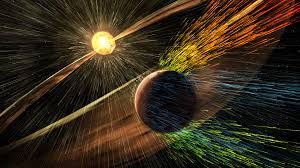
Photons are the source of light and heat, but they also cause solar wind which is far more destructive. As it reaches the surface, photons heat the outer layer of the sun creating extreme turbulence and extreme shock waves. It is so violent we can actually hear it.
The speeding gases also generate a powerful magnetic field. As the star rotates the field clash and burst through the surface. Giant magnetic loops erupt into space some are so large the earth can pass right through them.

To discover how magnetic loops trigger the solar wind a team of scientists at Cal Tech recreates the surface of the star. An airless chamber simulates the vacuum of space. An enormous electric current produces a pair of man-made magnetic loops.
Their experiment revealed that when magnetic loops clash in the lab, they trigger a massive burst of energy. When a giant loop collides on the surface of a star, the energy released sends temperature soaring from 10,000 to 10 million degrees. that extreme heat triggers the solar wind, sending millions of tons of particles streaming out into space. The bigger the star, the more deadly the wind.

wow
Leave A Comment