
By therandomsci / August 11, 2020
Keeping hands clean is the most important step to avoid getting sick and spreading disease to other.
Salmonella, E. coli O157, and norovirus present in Feces (poop) which is often found in people unwashed hands which is the main cause of diarrhea and some tipe of respiratory infection.
These germs get in people hand after using toilet, changing diaper and handling raw meat.
Germs can also get in our hand if we touch any object that has gems on it because someone cough, sneezed or touch it with unwashed hand.
When these germs get in our hands and are not washed off, they can be passed from person to person and can make everyone sick.
About 1.8 million children under the age of 5 die each year from diarrheal diseases and pneumonia, the top two killers of young children around the
world.
Handwashing with soap could protect about 1 out of every 3 young children who get sick with diarrhea and almost 1 out of 5 young children with respiratory infections like pneumonia.
Estimated global rates of handwashing after using the toilet are only 19%.
Handwashing helps battle the rise in antibiotic resistance.
Soap is a mixture of fat or oil, water, and an alkali, or basic salt. The basic recipe for soap don’t changed for thousands of years. When all the ingredients combine in the proper proportions, they go through a chemical process called saponification, which results in soap. There are two techniques that people use to make soap cold process and hot process.
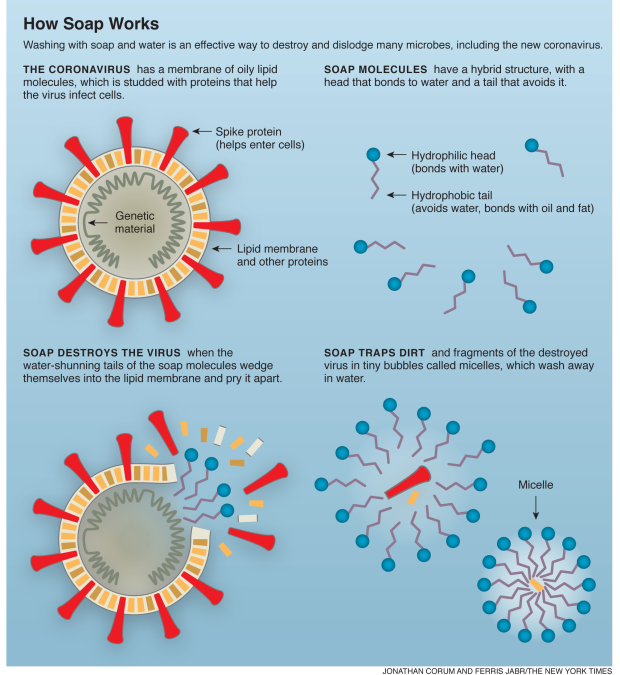
Soap doesn’t kill germs on our hands, it removes them. Germs stick to the oils and grease on our hands. Water alone can’t remove much of the germs on our hands because oil and water can’t mix. How long you should scrub depends on how dirty your hands are, but it is recommend at least 20 seconds. Once you’ve washed, be sure to air-dry or towel-dry. Wet hands are more likely to spread germs than dry ones, the CDC says.
Some soap molecules disrupt the chemical bonds that allow bacteria, viruses and grime to stick to surfaces, lifting them off the skin. Micelles can also form around particles of dirt and fragments of viruses and bacteria, suspending them in floating cages. When you rinse your hands, all the microorganisms that have been damaged, trapped and killed by soap molecules are washed away.
In 2016, the FDA issued a rule that antibacterial soaps were no longer allowed to be marketed to the public.
“Consumers may think antibacterial washes are more effective at preventing the spread of germs, but we have no scientific evidence that they are any better than plain soap and water,” Dr. Janet Woodcock, the director of the FDA’s Center for Drug Evaluation and Research (CDER), said in a statement. “In fact, some data suggests that antibacterial ingredients may do more harm than good over the long term.”
CDC recommends cleaning hands with soap and water, but if that’s not an option, then hand sanitizer is a good backup. Studies have found that hand sanitizer with alcohol concentrations of 60-95% are more effective at killing germs than nonalcohol or low-alcohol sanitizers.
The alcohol kills some bacteria and viruses by breaking down their protective membranes, which basically makes them fall apart. But it doesn’t work for all germs, such as norovirus, Clostridium difficile, which can cause life-threatening diarrhea, or Cryptosporidium, a parasite that causes a diarrheal disease called cryptosporidiosis, the CDC says. Hand sanitizers also likely don’t remove harmful chemicals like pesticides or heavy metals, nor does hand sanitizer work well on super dirty or greasy hands.
Hand washing with soap is, by far, the most effective way to keep harmful germs at bay.
https://www.livescience.com/57044-science-of-soap.html
https://www.cdc.gov/handwashing/why-handwashing.html
https://www.nytimes.com/2020/03/13/health/soap-coronavirus-handwashing-germs.html
Leave A Comment